How to Calculate Percent Change
Percent change is the difference between the new value and the old value, divided by the old value, times 100. From 1,200 to 1,500 is (1,500 − 1,200) ÷ 1,200 × 100 = a 25% increase. A negative answer is a decrease: from 1,500 back to 1,200 is a 20% decrease, because you're now dividing by the larger starting value.
The formula
Percent change = (new − old) ÷ old × 100
(1,500 − 1,200) ÷ 1,200 × 100 = +25%
The rule to remember: always divide by the starting value. That's what makes the answer a change "from" something, and it's where most mistakes happen.
Worked examples
| From | To | Change |
|---|---|---|
| $62,000 salary | $65,100 | +5% |
| $3.50 coffee | $4.20 | +20% |
| 180 lb | 171 lb | −5% |
| $1,200 rent | $1,500 | +25% |
| $1,500 | $1,200 | −20% |
Why increases and decreases aren't symmetrical
The last two rows of that table are the same two numbers, but one change is +25% and the other is −20%. That's not a contradiction: each is measured from a different starting point.
It has real consequences. If an investment falls 50%, it has to rise 100% to get back where it started: $100 falls to $50, and $50 has to double to return to $100. A 50% gain followed by a 50% loss leaves you with less than you started with, not the same: $100 rises to $150, then falls to $75.
The same goes for prices. A store that raises a price 25% and later announces "20% off" has only put it back where it was.
Percent versus percentage points
When the thing that's changing is itself a percentage, like an interest rate, a tax rate or an approval rating, there are two ways to describe a change, and they're easy to confuse:
- A rate going from 4% to 5% rose by 1 percentage point: the plain difference.
- It also rose by 25 percent: 1 is 25% of 4.
Both are correct, but they sound very different. "Rates rose 25%" is more dramatic than "rates rose one point", for the same event. When precision matters, say which one you mean.
Working backward
Percent change works in reverse too:
- New value after a change: old × (1 + change). $62,000 with a 5% raise is $62,000 × 1.05 = $65,100.
- Old value before a change: new ÷ (1 + change). If rent is $1,500 after a 25% increase, it was $1,500 ÷ 1.25 = $1,200. Subtracting 25% of $1,500 gives $1,125, which is wrong for the same reason as above.
Percent change and percent difference
Percent change has a direction: from one value to another. Percent difference compares two values without a "before" and "after", like the prices at two stores, by dividing the difference by their average. For 1,200 and 1,500, the difference of 300 divided by the average of 1,350 is 22.2%. Use percent change for anything over time, and percent difference when neither value is the starting point.
Using the Percent Change Solver
coolca.lc's Percent Change Solver has three slots: From, To and Change %. Fill in any two and the third shows SOLVE.
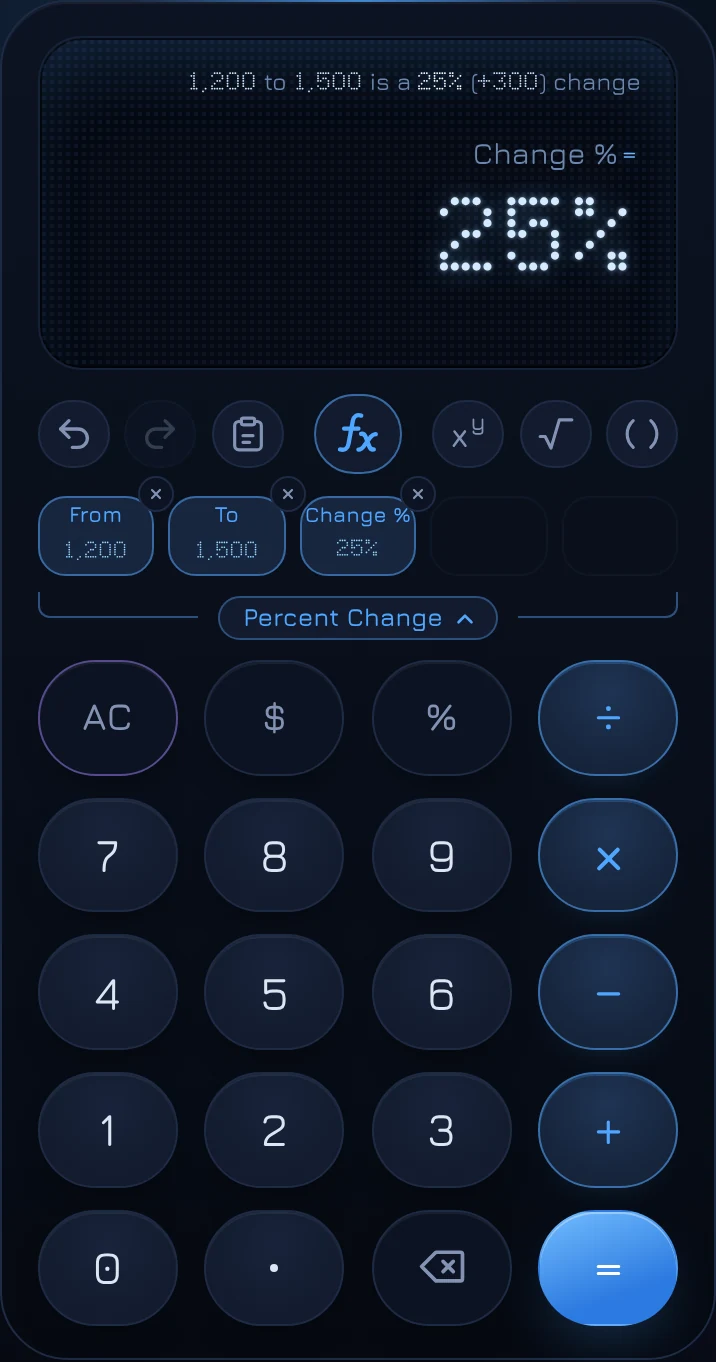
- Open Percent Change.
- Type the starting value, such as 1200, and tap From.
- Type the new value, such as 1500, and tap To.
- Tap Change %, which shows SOLVE.
To apply a change, fill in From and Change % and tap To; use a negative percentage for a decrease. To find a starting value, fill in To and Change % and tap From. From and To can be money or plain numbers; mark them with $ and the result follows.
For a quick increase or decrease without a Solver, the main calculator understands it directly: 1,200 + 25% is 1,500. See how percentages work.
Questions
What if the starting value is zero?
Percent change from zero isn't defined, because you'd be dividing by zero. Going from 0 to 50 is an increase of 50, but not any percentage of nothing.
Can percent change be more than 100%?
Yes. Going from 50 to 150 is a 200% increase: the value tripled. A decrease can never be more than 100%, since that would take a value below zero.
How do I find the average yearly growth over several years?
Not by dividing the total change by the number of years, since each year's growth builds on the last. For steady growth at a fixed rate, the Savings Growth Solver does the compounding for you.