Markup vs Margin
Markup and margin describe the same profit from two directions. Markup is profit as a percentage of the cost; margin is profit as a percentage of the selling price. An item that costs $2,000 and sells for $2,500 has a $500 profit: that's a 25% markup ($500 ÷ $2,000) and a 20% margin ($500 ÷ $2,500). Same item, same profit, two different percentages.
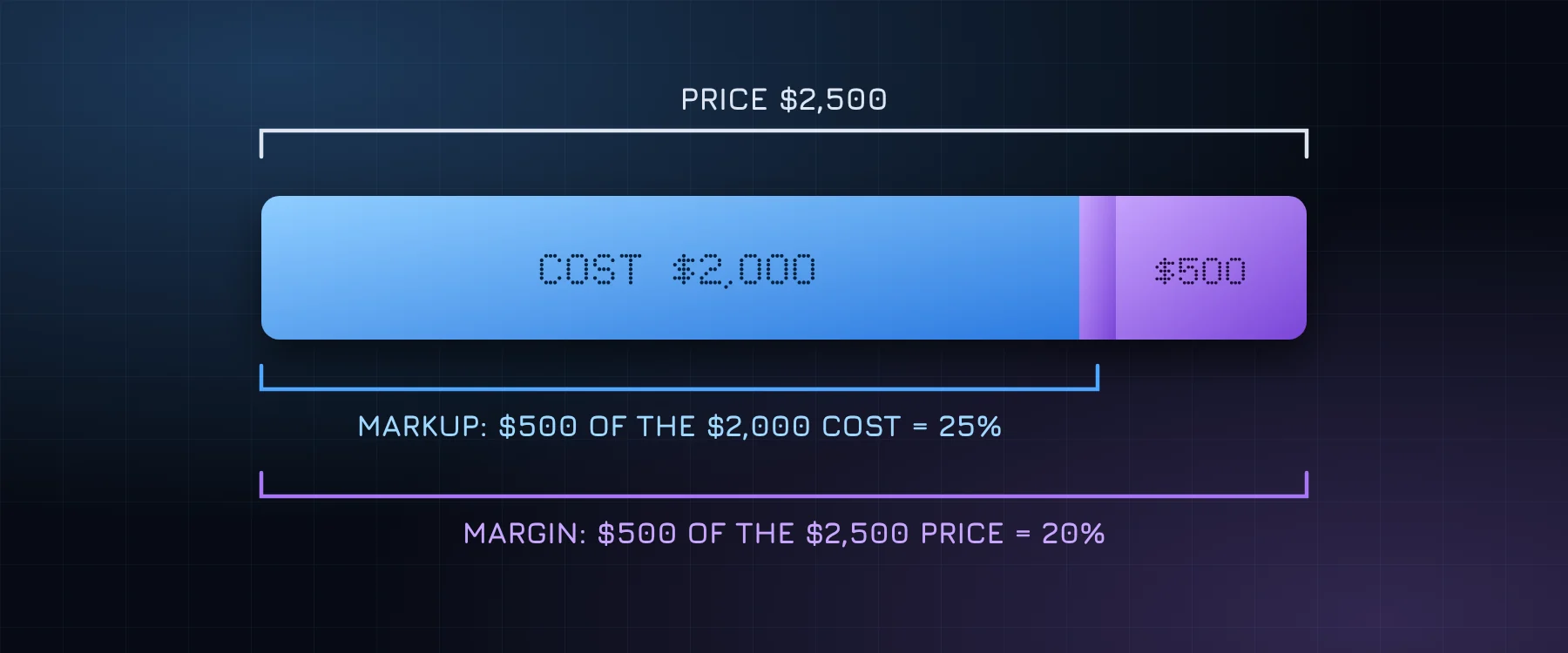
The formulas
| Markup | Margin | |
|---|---|---|
| Percentage | profit ÷ cost × 100 | profit ÷ price × 100 |
| Price from cost | cost × (1 + markup) | cost ÷ (1 − margin) |
| Cost from price | price ÷ (1 + markup) | price × (1 − margin) |
Profit is always price minus cost, in dollars. Only the percentage changes depending on what you divide by.
The classic pricing mistake
Say you want a 20% margin on an item that costs $2,000. It's natural to add 20%: $2,000 × 1.2 = $2,400. But a $400 profit on a $2,400 price is a margin of only 16.67%. Adding a percentage to cost gives you a markup, and markup is always a bigger number than the margin it produces.
To actually earn a 20% margin, divide by 1 minus the margin: $2,000 ÷ 0.8 = $2,500. The $500 profit is 20% of $2,500.
On a single sale the difference looks small. Across a year of sales, pricing to the wrong percentage quietly takes a fifth of the intended profit off the top.
Markup to margin conversion table
| Markup | Margin |
|---|---|
| 10% | 9.09% |
| 20% | 16.67% |
| 25% | 20% |
| 33.33% | 25% |
| 42.86% | 30% |
| 50% | 33.33% |
| 66.67% | 40% |
| 100% | 50% |
To convert yourself:
- Margin from markup: markup ÷ (1 + markup). A 50% markup is 0.5 ÷ 1.5 = 33.33% margin.
- Markup from margin: margin ÷ (1 − margin). A 40% margin is 0.4 ÷ 0.6 = 66.67% markup.
Margin can never reach 100%, since that would mean the item cost nothing. Markup has no ceiling: an item that costs $1 and sells for $5 has a 400% markup and an 80% margin.
Which should you use?
Markup is the natural tool for setting prices from costs. It's how many retailers, contractors and wholesalers think: "we mark everything up 50%". It's easy to apply at the moment of pricing.
Margin is the natural tool for understanding a business. Margins can be compared across products and against your revenue: a 30% gross margin means 30 cents of every sales dollar is left after the cost of goods. Accountants, investors and financial statements speak in margin.
The safe habit is to know which one anyone is quoting. "We need 40%" means a very different price depending on whether it's markup or margin.
Using the Markup and Margin Solvers
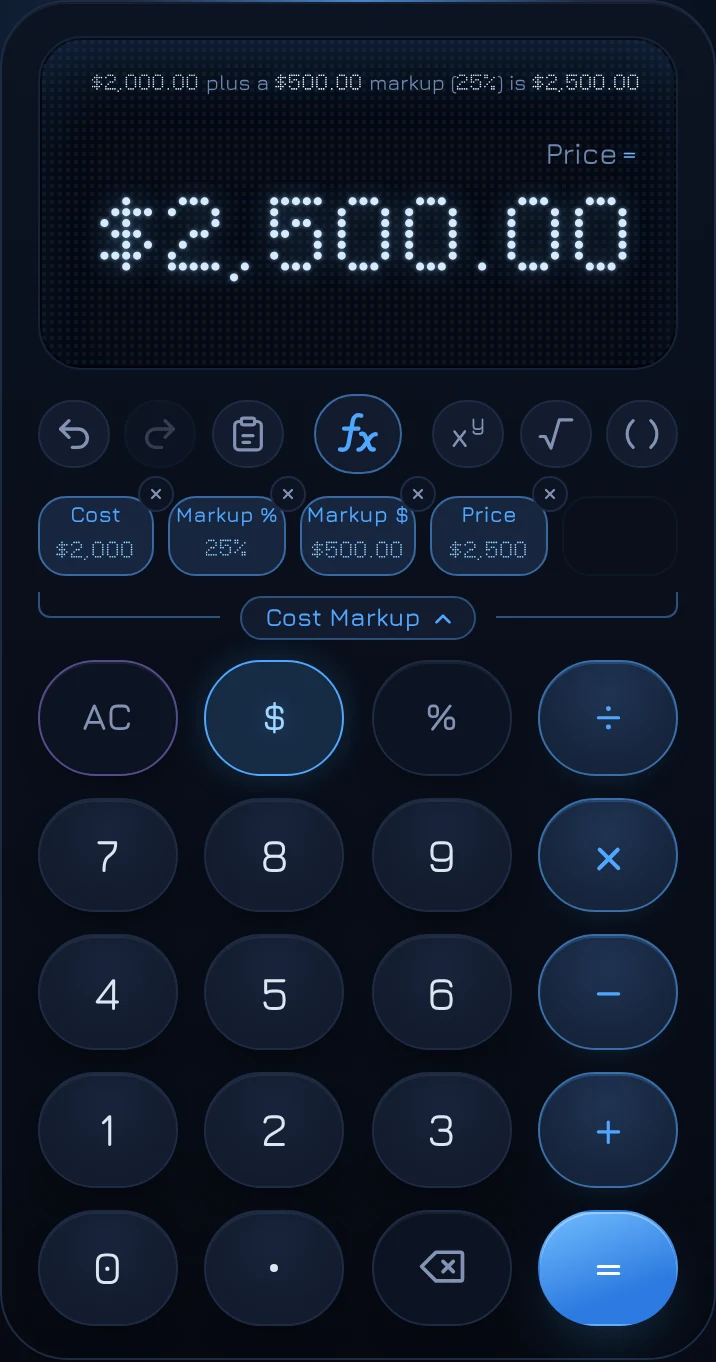
coolca.lc has a Solver for each: Cost Markup, with slots for Cost, Markup %, Markup $ and Price, and Profit Margin, with Cost, Margin %, Profit $ and Price. They're linked Solvers: give any two values and they fill in the other two, as long as the two aren't the percentage and its dollar amount (those describe the same thing, so entering one replaces the other).
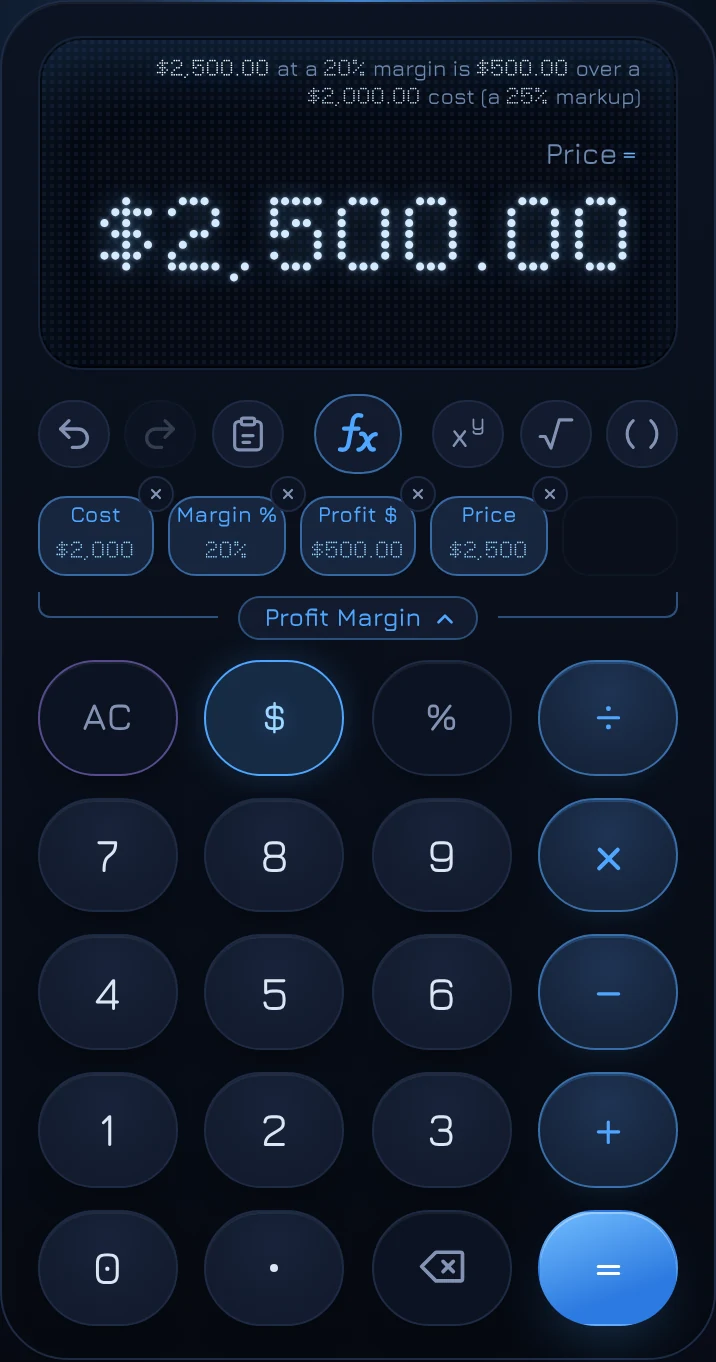
Pricing from a cost
- Open Profit Margin.
- Type the cost, such as 2000, and tap Cost.
- Type the margin you want, such as 20, and tap Margin %.
- Price and Profit $ both show SOLVE. Tap either one and both fill in.
The Profit Margin Solver also shows the equivalent markup in the line above the result, so you always see both numbers.
What-if: changing one value
Once a linked Solver is filled in, it works like a small what-if sheet. Type a new value into any slot and the others dim, keeping their old values, and show SOLVE. Then tap the one you want to move:
- Change Margin % and tap Price: the cost stays, and you see the new price.
- Change Price and tap Margin %: the cost stays, and you see the margin at that price.
- Change Price and tap Cost: the margin stays, and you see what the item would need to cost.
The Cost Markup Solver works the same way, with markup in place of margin.
Questions
Is gross margin the same as profit margin?
Gross margin is the margin on the cost of goods alone, which is what these formulas measure. Net profit margin also subtracts overhead such as rent, wages and marketing, so it's always lower. When someone quotes a product's margin, they nearly always mean gross margin.
Can markup be over 100%?
Yes, and it often is for low-cost goods. A 100% markup doubles the cost and gives a 50% margin; a 200% markup triples it and gives a 66.67% margin.
Do discounts come out of margin or markup?
A discount comes out of the selling price, so it eats into margin directly. A 20% discount on an item priced at a 20% margin leaves no profit at all.