How Loan Payments Are Calculated
A loan's monthly payment depends on three things: how much you borrow, the interest rate, and how long you take to repay it. A $25,000 loan at 6.5% for 5 years costs $489.15 a month, and about $4,349 in interest over the life of the loan. Stretch it to 6 years and the payment drops to $420.25, but the interest rises to about $5,258.

The loan payment formula
Most car loans, personal loans and mortgages are amortizing loans: every payment is the same, and each one covers that month's interest plus a little of the balance, so the loan reaches zero on the final payment. The payment is:
Payment = loan × r ÷ (1 − (1 + r)−n)
where r is the monthly rate (the annual rate ÷ 12) and n is the number of monthly payments.
For $25,000 at 6.5% for 5 years, r = 0.065 ÷ 12 ≈ 0.005417 and n = 60, which gives $489.15. It's not a formula anyone enjoys doing by hand, which is exactly what the Loan Payment Solver is for.
Where your payment goes
Each month, interest is charged on the balance you still owe, and whatever is left of your payment reduces the balance. In month one of that $25,000 loan, interest is $25,000 × 0.005417 = $135.42, so only $353.73 of the $489.15 payment goes to the balance. As the balance shrinks, each month's interest shrinks with it, and more of the same payment goes to the loan itself. By the last year, nearly the whole payment is paying down the balance.
That's why extra payments early in a loan save the most. Every extra dollar comes off the balance and stops collecting interest for the rest of the term.
How the rate and term change what you pay
All of these are for a $25,000 loan:
| Rate and term | Monthly | Total interest |
|---|---|---|
| 4.5%, 5 years | $466.08 | $2,964.53 |
| 6.5%, 4 years | $592.87 | $3,457.94 |
| 6.5%, 5 years | $489.15 | $4,349.22 |
| 6.5%, 6 years | $420.25 | $5,257.87 |
| 8.5%, 5 years | $512.91 | $5,774.80 |
Two lessons stand out. A longer term lowers the payment but costs more in total, because you owe the money for longer. A lower rate is worth shopping for: on this loan, 4.5% instead of 8.5% saves about $2,810.
The same math drives mortgages, at a larger scale. A $300,000 mortgage at 6.5% costs $1,896.20 a month over 30 years, with about $382,633 in interest, more than the loan itself. Over 15 years the payment is $2,613.32, and the interest falls to about $170,398.
Rate, APR and fees
The interest rate is what's charged on the balance. The APR (annual percentage rate) folds in certain fees and costs as well, so it's usually a little higher, and it's the better number for comparing offers from different lenders. For working out a payment from an interest rate, use the interest rate; that's what the Loan Payment Solver expects.
Using the Loan Payment Solver
coolca.lc's Loan Payment Solver has four slots: Loan, Rate %, Years and Monthly. Fill in any three and the fourth shows SOLVE.
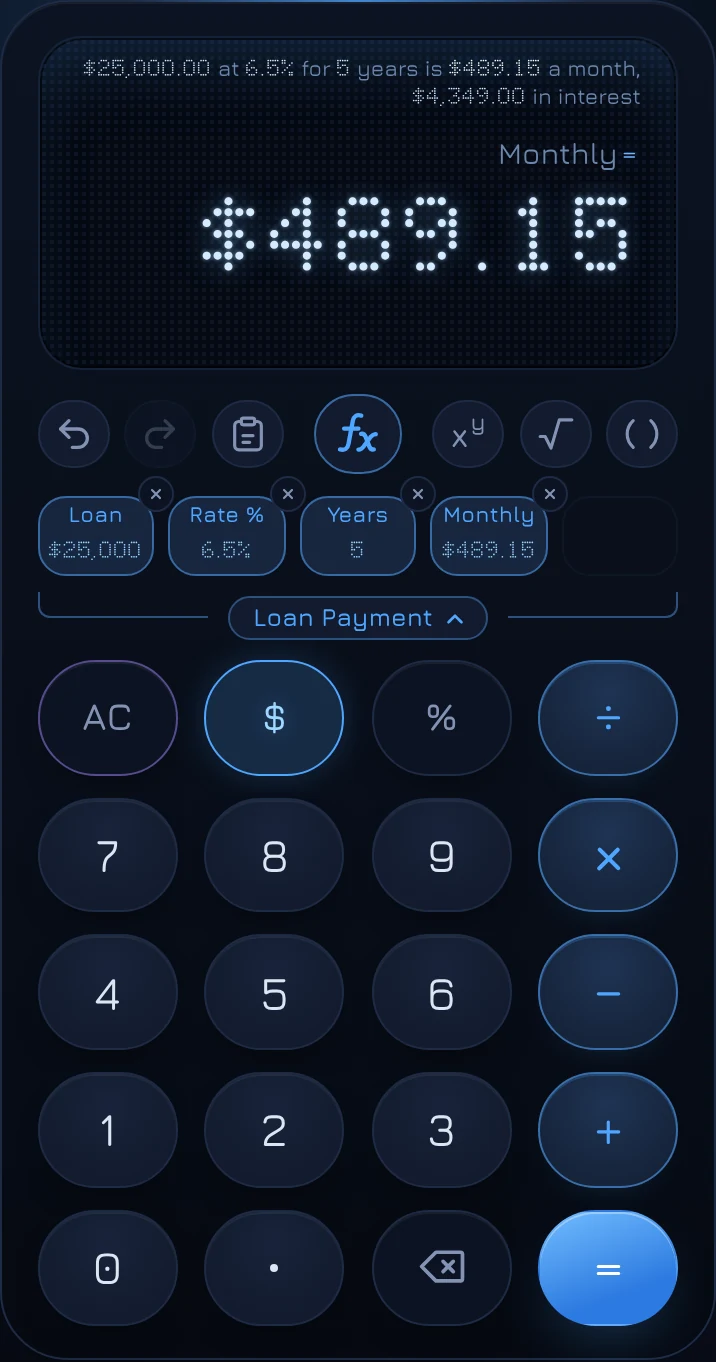
Finding the monthly payment
- Open Loan Payment.
- Type the amount, such as 25000 (or 25 and hold 0 for thousands), and tap Loan.
- Type the interest rate, such as 6.5, and tap Rate %.
- Type the term, such as 5, and tap Years.
- Tap Monthly, which shows SOLVE.
The line at the top of the display adds up the interest over the life of the loan. Change the rate or the term, by typing a new value and tapping its slot, and the payment updates immediately, which makes comparing offers quick.
How much can I borrow?
Put the payment you can afford in Monthly, along with a rate and a term, and tap Loan. At 6.5% over 5 years, $400 a month supports a loan of about $20,443.
What rate is this offer?
If a dealer quotes a payment but not a rate, fill in Loan, Years and Monthly, and tap Rate %. The Solver searches for the rate that produces that payment, so you can compare the offer with a bank's.
How long will it take?
Tap Years with the other three filled in. If the payment doesn't cover the monthly interest, the loan would never be paid off, and the Solver says so. For credit cards and other balances you're paying down, the Payoff Time Solver counts the months directly.
Questions
Does this include taxes, insurance or fees?
No. It's the loan payment itself: principal and interest. A mortgage payment often also includes property tax and insurance held in escrow, and a car loan may roll in fees, so your lender's quote can be higher.
What about a 0% loan?
It works. At 0%, the payment is simply the loan divided by the number of months: $10,000 over 2 years is $416.67 a month.
Why is the interest in the Solver slightly different from the table?
The Solver adds up the payments as they'd actually be charged, rounded to the cent, so its interest total can differ from an unrounded calculation by a few cents.